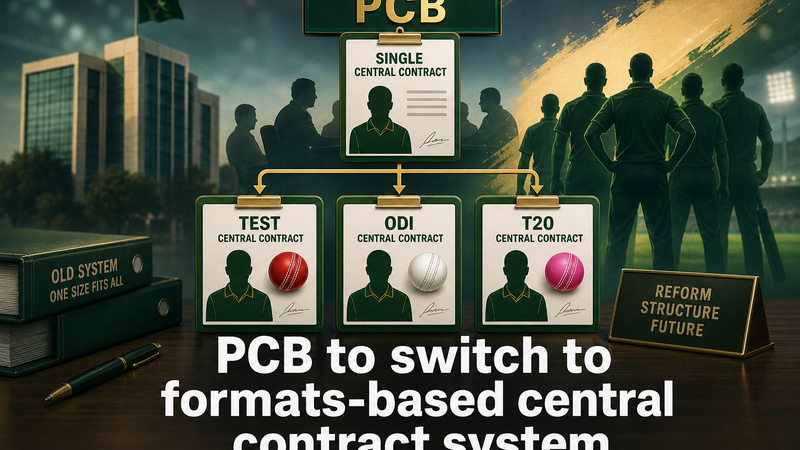
The Pakistan Cricket Board will abandon its traditional A-to-D central contract categories and introduce a format-focused system that separates specialists across Test, ODI, and T20 cricket. Chairman Mohsin Naqvi announced the change at a press conference alongside coaches Aaqib Javed and Mike Hesson, saying the new model will lean heavily on analytics and that most contract decisions will be driven by data rather than individual judgment.
Naqvi said past contracts often sparked debate about why players were placed in certain tiers, with some athletes unhappy about their category. The board has prepared a framework in which roughly 85% of contract outcomes are intended to be determined by measurable criteria instead of subjective calls.
Under the new structure, players will no longer sit in four graded bands from A to D. Instead, they will be assigned to format tracks. Test specialists will be placed on track A, dual Test-and-ODI players on track AB, white-ball players on track BC, and T20 specialists on track D.
Track D is designed to give players greater freedom to appear in franchise leagues worldwide. The tightest restrictions will apply to Test specialists, who the board says will receive the strongest financial backing to reflect the value placed on red-ball cricket and to make a Test-focused career more rewarding.
Naqvi argued the criteria for track placement are transparent and not controlled by individuals, so players should have fewer grounds to dispute their classification. However, the board will not publicly reveal which track each player has been assigned to, or how many cricketers sit in each track. That means fans and media will not know whether the PCB internally views a player as a Test specialist or a white-ball cricketer, even though those designations will shape league clearance and selection thinking.
Officials stressed that data analytics now plays a central role in selection and contracting. The system has reportedly been trialled at domestic level over the past year. Hesson said Test nations broadly face the same challenge of valuing long-form cricket financially while allowing T20 players to develop through global leagues. He described the PCB framework as a serious attempt to protect Test cricket while rewarding short-format specialists.
Another key theme is greater domestic involvement. The document states that active participation in domestic cricket will be mandatory for central contract eligibility. While the exact threshold was not defined, performances, commitment to a chosen pathway, and results within that pathway will all be assessed.
Aaqib said the approach marks a shift from past selection habits, pointing to impact-style metrics that measure a player’s contribution to winning rather than raw totals alone. He noted that contract disputes had affected players and selectors alike last year, and that the board wanted a fairer, more consistent process.
The new system takes effect when the current central contract cycle ends at the end of this month.